
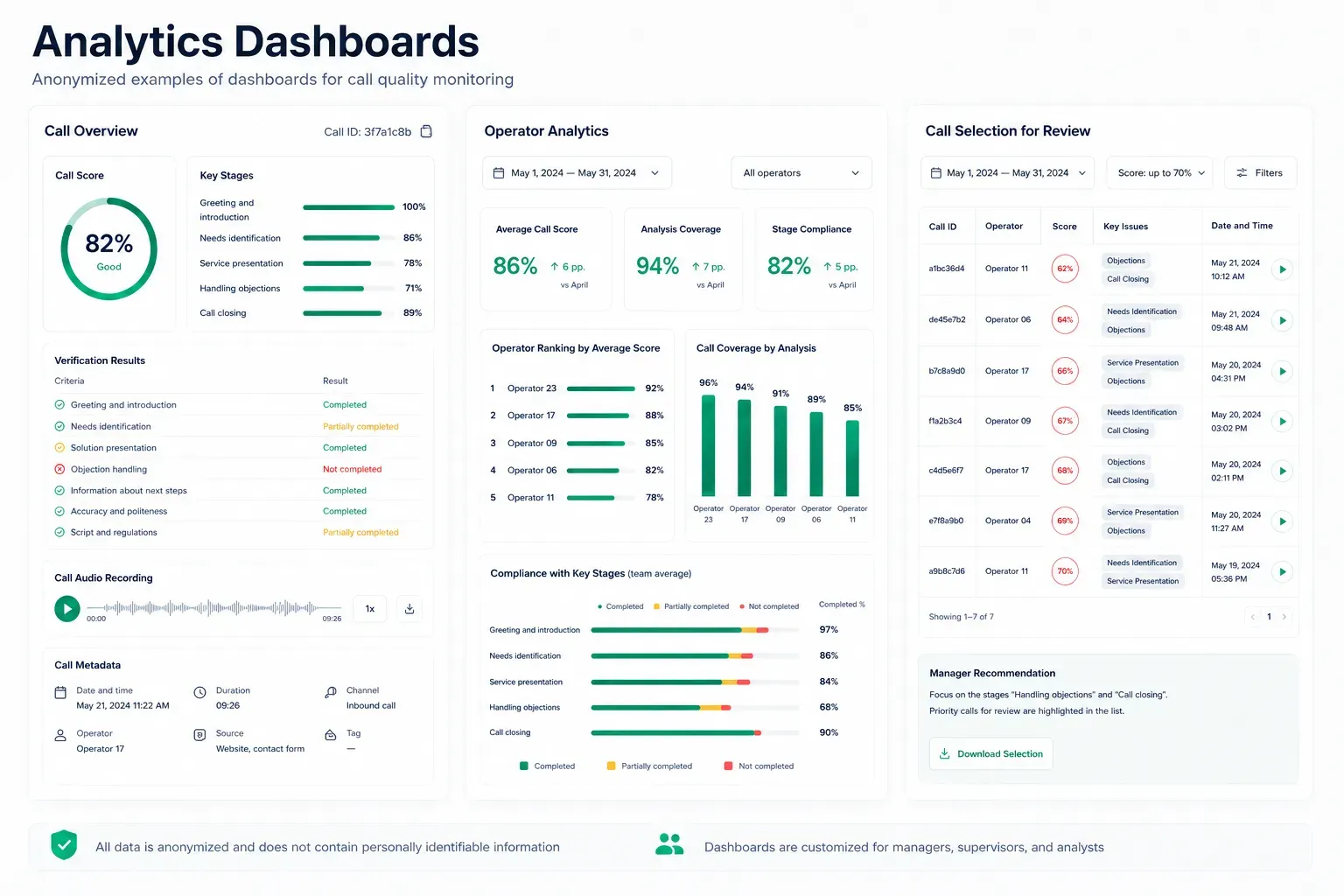
Deeray helped a network of medical clinics transition from selective call checking to analyzing 100% of communications, determine conversation parameters linked to patient booking and attendance, and restructure their quality assurance processes.
Key Results
 +20%growth in call-to-booking conversion rate
∙100% of callsautomated analysis instead of manual checking of 5–7%
- over 40% growth in compliance with standards at the presentation and objection-handling stages.
What it was like before Deeray: Quality control covered only 5–7% of calls
The network of medical clinics processed around 80,000 minutes of conversations per month. The Quality Assurance (QA) department physically could not check the entire volume: they manually reviewed only 5–7% of calls, and the review results could take 2–3 weeks to appear.
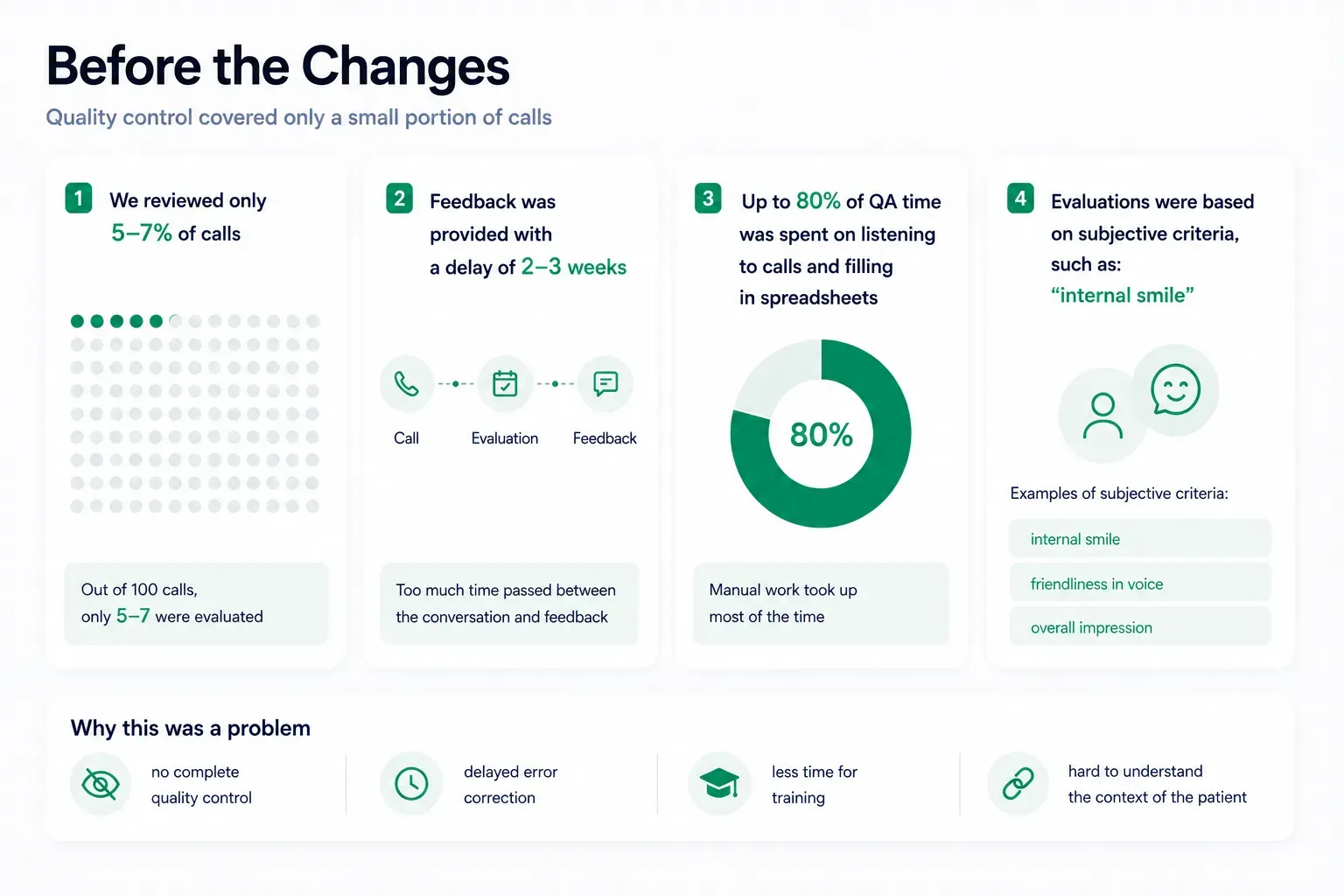
About 80% of the QA controllers' time was spent listening to conversations and filling out spreadsheets. Only about 10% of the time remained for training operators. Moreover, the evaluation used not only measurable parameters but also subjective criteria — for example, an "inner smile."
This approach showed the quality of a small sample but did not allow a reliable understanding of which communication features were truly linked to patient booking and attendance.
Before / After
| Before | After |
|---|---|
| Checked 5–7% of calls | Analyze 100% of calls |
| Results in 2–3 weeks | Results the next day |
| Manual control | Automated analysis |
| Subjective criteria | Metrics linked to business results |
| QA department mainly checks | QA department focuses more on training |
What Deeray did: Linked conversation parameters to business results
The team started not with a universal checklist, but with full coverage of communications and segmentation of scenarios by medical specialties.
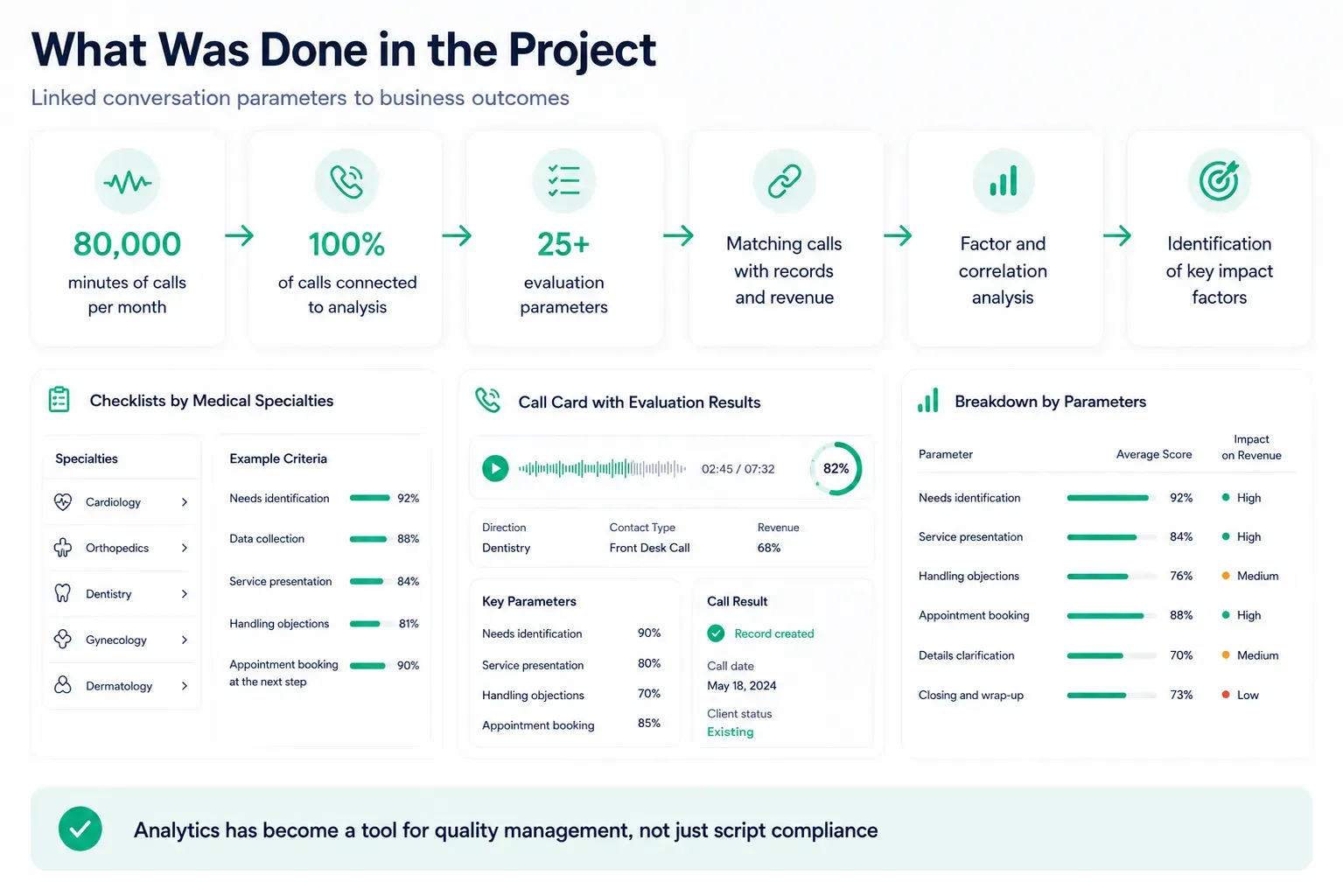
1. Connected 100% of calls
Instead of selective manual checking, Deeray began automatically analyzing the entire volume of calls. Results became available as early as the next day.
2. Segmented scenarios by medical specialties
Separate checklists were configured for different specialties so as not to evaluate all calls using a single scheme.
3. Configured 25+ evaluation parameters
The analysis included over 25 communication criteria. This provided sufficiently detailed tagging to compare different elements of the conversation with the outcome.
4. Matched conversations with bookings and attendance
Call parameters were compared not only with internal quality scores but also with the actual result — patient appointment booking and attendance (show-up rate).
5. Conducted factor and correlation analysis
The team looked for which conversation parameters were statistically linked to the result, and which did not provide a useful signal for quality management.
Analysis Scheme
100% of calls → 25+ parameters → matching with bookings and attendance → identification of significant factors → process changes
Thus, the medical clinic's call analytics became a tool not just for script control, but for verifying which communication elements are truly linked to business results.
What was discovered: Not all traditional criteria affected the result equally
The analysis highlighted three stages of communication where it was important to focus:
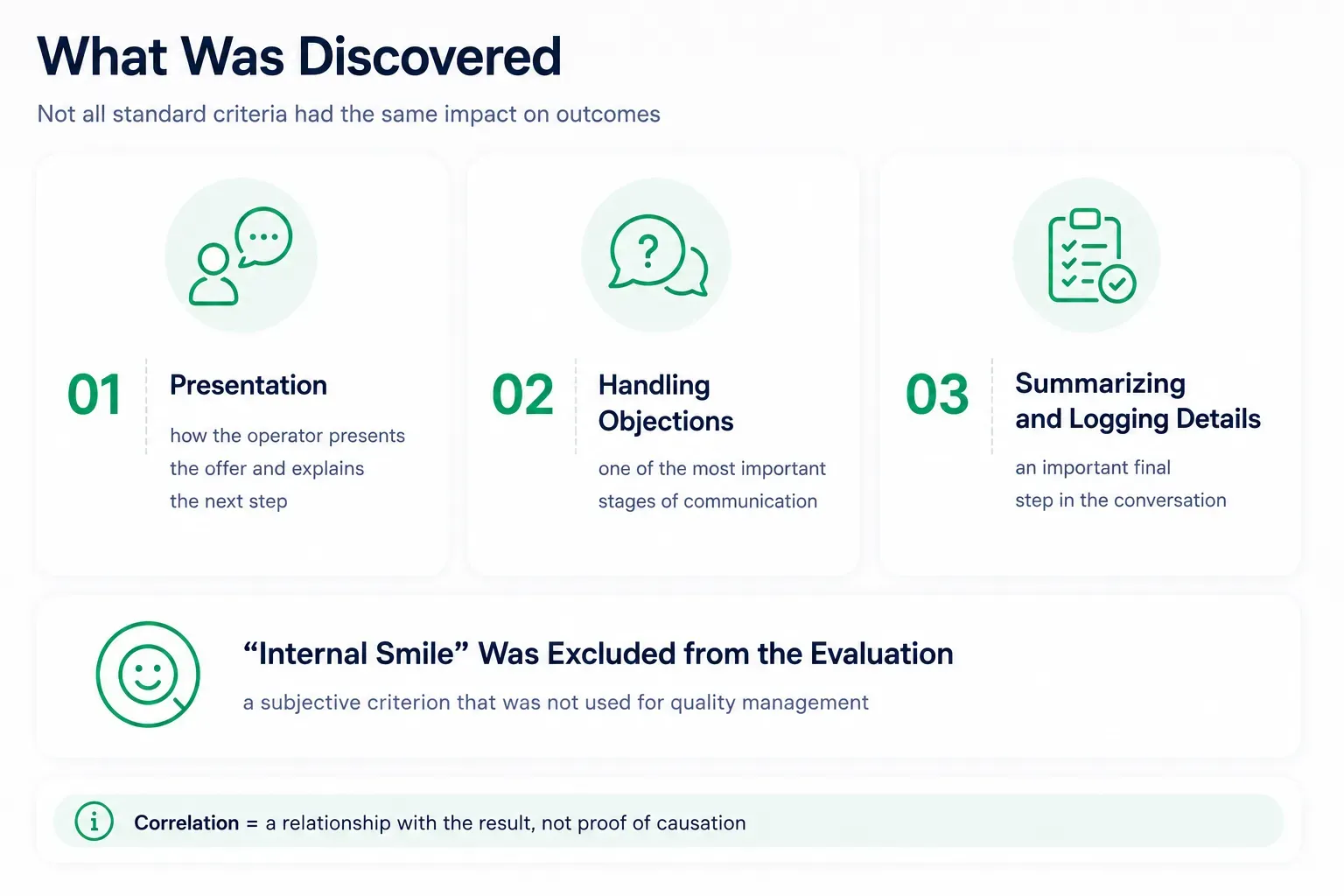
Presentation
How the operator presents the offer and explains the next step became one of the key parameters for future work.
Objection handling
This stage also proved significant. Therefore, it was strengthened in both the scripts and subsequent call quality control.
Summarizing and recording booking details
The final part of the conversation — confirming agreements and appointment details — became a separate area of attention.
At the same time, the analysis showed that not every traditional call quality metric is linked to business results. For example, the subjective criterion of an "inner smile" was no longer used as a basis for further quality management. It was eliminated along with other unnecessary subjective indicators.
This changed the very principle of operator evaluation: instead of "this is how we are supposed to check," the focus shifted to parameters for which a link to patient booking and attendance was found in the data. Correlation was viewed as a connection, not as proof of causation.
What the client changed after the analysis
Based on the results, the network of medical clinics restructured its quality control and operator training processes.
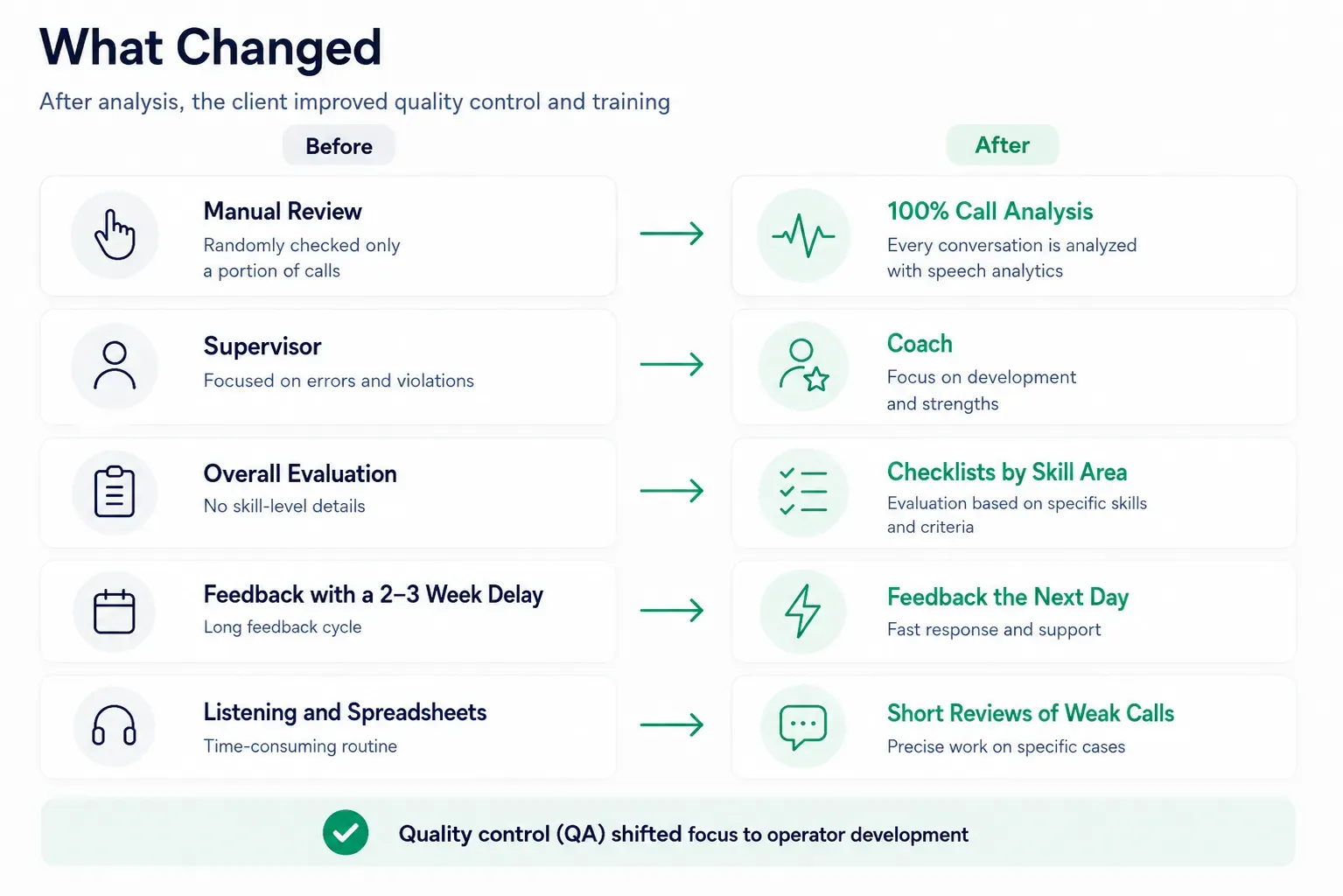
Revised checklists and scripts
Checklists were cleared of unnecessary subjective criteria. Scripts were segmented by medical specialties, and the stages of presentation, objection handling, and summarizing were strengthened.
Changed KPIs
The evaluation system added more objective parameters linked to communication outcomes and reduced the role of subjective criteria.
Accelerated feedback
Operators began receiving information about errors the next day, rather than in 2–3 weeks. This allowed for faster review of specific conversations while the context was still relevant.
Introduced short reviews of weak calls
Supervisors began conducting 15-minute reviews of calls where weaknesses were found at key communication stages.
Redirected QA time to training
Automation removed a significant portion of routine checking. The QA department was able to shift its focus from listening and spreadsheets to operator development.
Scaling without increasing QA staff: When connecting new branches, the client maintained the same QA staff size; the growth in control volume did not require a proportional expansion of the team.
Results
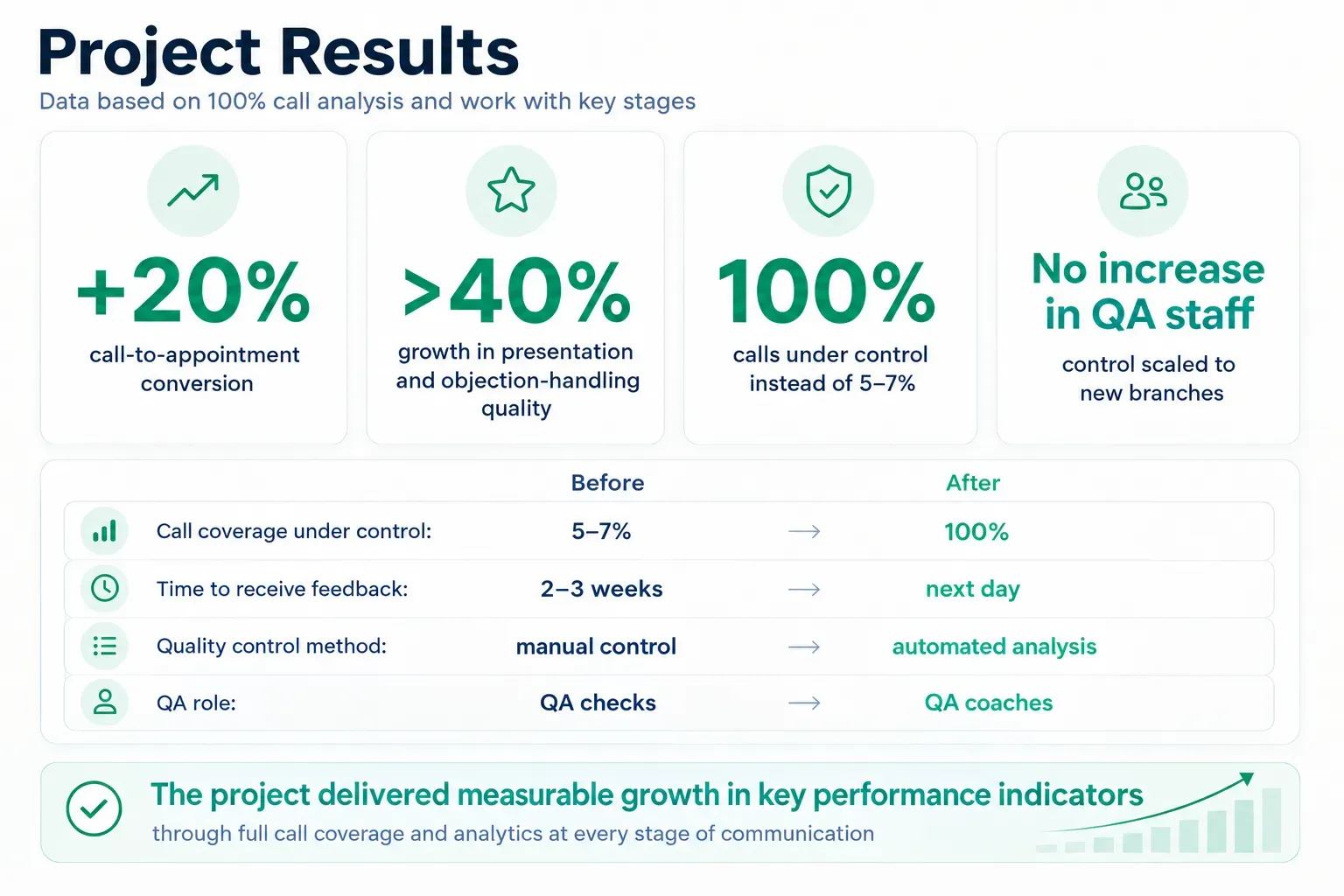
+20% to call-to-booking conversion
After the changes, call-to-booking conversion grew by 20%. This is the main business result of the project.
Over +40% to compliance with standards at key stages
Metrics for presentation and objection handling grew by more than 40%.
100% of calls under control instead of 5–7%
The network transitioned from selective manual checking to automated analysis of the entire communication volume.
New branches without increasing QA staff
Control was successfully scaled to new branches without expanding the quality assurance team.
Analyzing not just call quality, but its connection to bookings
Deeray helps match communication parameters with patient booking and attendance to see which conversation elements should be changed first.
See what Deeray finds in your calls
We'll demonstrate in a demo how AI analyzes communications, identifies points of patient loss, and helps identify factors affecting recording.